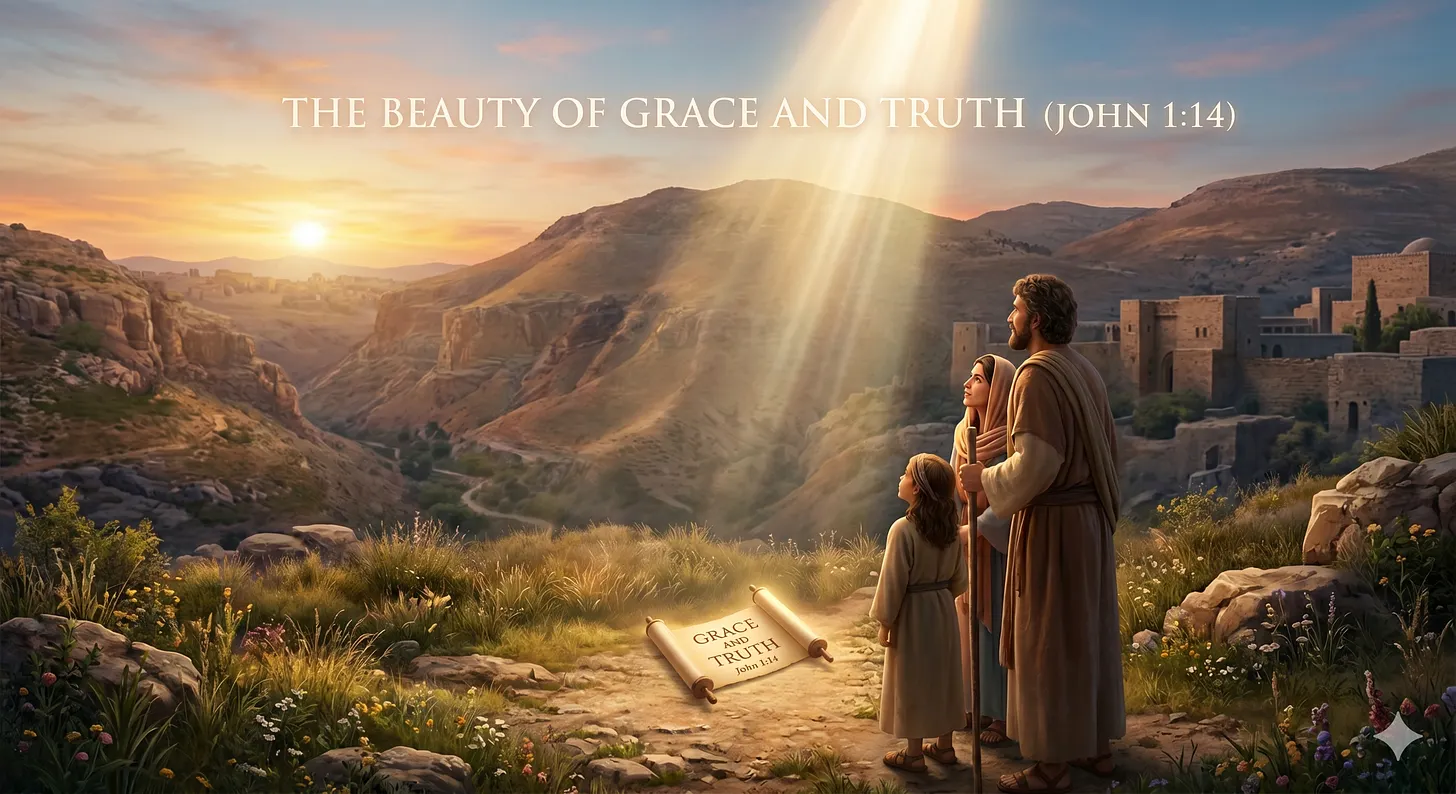
The Beauty of Grace and Truth (John 1:14)
Reconciling the Rigid Blade of Truth (Law) with the Radiant Geometry of Mercy
Humanity is often paralyzed by a perceived schism between the unyielding blade of Truth (Law) and the protective shield of Mercy. We have long functioned within a binary that suggests one must choose between the cold clarity of fact and the warm embrace of kindness. Yet, ancient priestly traditions and the precise numerical synthesis of the "Mathematics of the Spirit" reveal a more profound reality: Truth without Beauty is an incomplete vibration, and Beauty without Truth is a hollow mask. To move beyond the crude "stick" of judgment, we must understand how Truth was meant to be modified, sprouted from the earth, and woven into a garment of glory.
Why Truth Was "Cast Down" to Earth
There is a startling tradition regarding the creation of man and the nature of the absolute. When the Divine intended to bring humanity into existence, Truth (Law)stood in opposition. In its heavenly, abstract form, Truth was an obstacle to God’s love for the fallible. It argued that man should never be created because man is inherently a liar—a being of inconsistency. Truth (Law), in this crude and heavenly state, was a zealot, demanding perfection or non-existence.
The source context illuminates this divine tension:
"Truth stood in the way and challenged God about creating man because man would be a liar. God’s response was to cast Truth down to the earth."
This act of casting Truth down was not a punishment, but a modification. By grounding Truth in the soil of human experience, God commanded that "Truth shall sprout out of the earth" (Psalm 85:11). Truth had to be planted in the soil of human fallibility to learn the language of the earth; it had to grow alongside mercy to become something beautiful and indwelling rather than remaining a harsh, external judgment.
The Abrahamic Modification: From Zealot to Host
The patriarch Abraham serves as the quintessential study of this spiritual evolution. In his youth, Abraham was a "Zealot of Truth." Legend describes him as a young man who took a physical stick and smashed his father’s idols—a period of "Strict Truth" where destruction was the primary tool for righteousness. This was the era of the stick, a crude and unyielding strategy.
However, as Abraham moved into the land of promise, he underwent what is known as "Modifying the Strategy." (Micah 7:20). He transitioned from the destroyer of idols to the practitioner of Hessed (Loving Kindness). He shifted his posture from the zealot to the Host, opening his tents to strangers and interceding even for the wicked of Sodom.
This internal alchemy was so profound that it altered his perception of reality. The tradition suggests that Abraham only truly recognized the radiant beauty of his wife Sarah (Genesis 12:11), after he integrated mercy into his life and modified his rigid strategy. It reveals a timeless principle: our eyes are only opened to the "Glory and Beauty" of creation when our unyielding "Truth" is tempered by the softness of kindness.
The Divine Equation: The Gematria of a Kingdom
The intersection of these virtues is not merely philosophical; it is mathematical. In the "Spiritual Calculus" of the Kingdom, the numerical values of these concepts reveal the requirements for a complete spiritual structure:
• Truth (Emet) = 441
• Beauty = 100
• Israel (The Result of Truth + Beauty) = 541
• Mercy (Hessed) = 72
• The Completed Torah/Kingdom (541 + 72) = 613
This equation demonstrates that even "Israel"—the union of Truth (441) and Beauty (100)—is insufficient on its own. To reach 613, the number signifying the "Beginning of the Kingdom" and the "Feminine Yoke" of total acceptance of the Divine Will, one must add the 72 of Mercy. Without Loving Kindness, the spiritual structure remains 72 points short of the Kingdom. The 613 represents the moment Truth, Beauty, and Mercy finally converge to create a functional, living law.
The Danger of Extremes: Ugly Truth vs. Empty Beauty
The spiritual path warns against two specific failures, described as the "two tossings" of ministry:
1. "Ugly Truth": This is truth that is harsh, judgmental, and devoid of aesthetic or kindness. It is the zealot’s stick. Because it cannot coexist with the human condition, it was "cast down to earth" to be buried and sprouted anew.
2. "Empty Beauty": This is "grace" or aesthetic without the foundation of Truth. It is deceptive, lacking the bone-structure of reality. This empty aesthetic is said to be "tossed to hell" because it offers a form of godliness while denying its transformative power.
The true Royal Priest avoids these extremes by donning "Holy Garments" that balance the scales:
"Your brother Aaron shall have holy garments for glory and for beauty... This ministry is not ordinary; it is meant to be glorious and beautiful." (Exodus 28:2)
Conclusion: Sprouting Truth in a Modern World
The mission of the modern seeker is to set down the "harsh stick" of the young Abraham and adopt the "Water Libation" of the mature priest. We are called to be Truthfully Beautiful and Beautifully Truthful. We must recognize that Truth only finds its ultimate purpose when it sprouts from the earth, watered by Hessed and adorned with the glory of a kind spirit.
As you navigate a world fractured by ideological wars and judgmental silos, reflect on the nature of your own conviction: Is your Truth currently a "harsh stick" used to smash those you disagree with, or is it a seed currently sprouting with the 72 of mercy? Only when we balance the equation can we hope to inhabit the "613" of a truly established Kingdom.